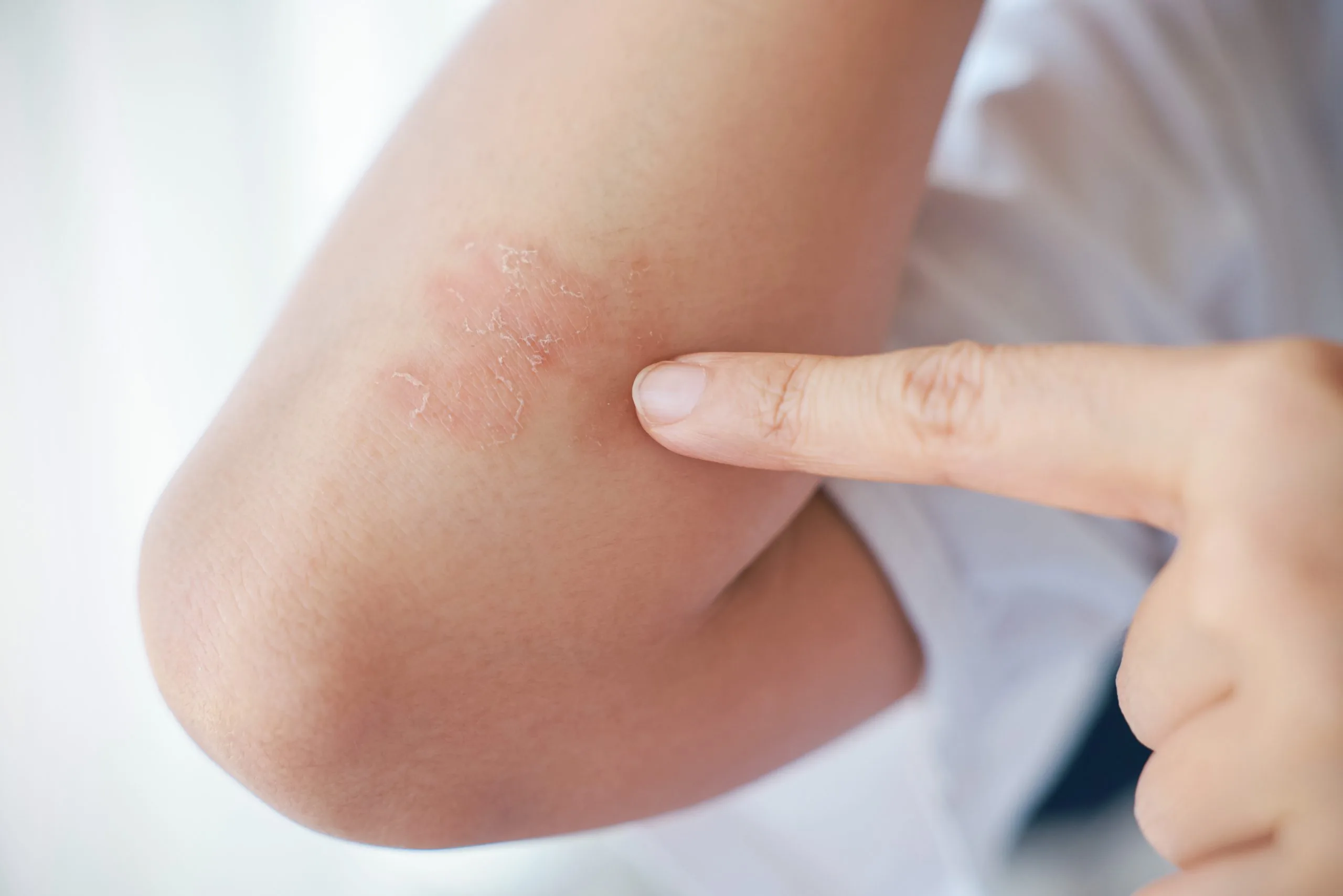
The treatments that actually work for psoriasis are those matched to the severity of the disease: prescription topicals (including newer non-steroidal options like tapinarof) for limited plaques, phototherapy for widespread but moderate disease, and oral systemics or biologics for moderate-to-severe psoriasis that topicals can’t control. Moisturizers, gentle skin care, and lifestyle adjustments enhance the effectiveness of these treatments, but on their own, they rarely clear plaques.
At Everoak Dermatology in Celina, TX, our team creates a layered plan tailored to your specific needs and adjusted over time.
Psoriasis is a chronic, immune-driven condition in which skin cells multiply far faster than normal, piling up into raised, scaly plaques that can itch, crack, burn, or bleed. Some people have a few coin-sized patches on their elbows and knees. Others have plaques across their scalp, trunk, and limbs. Nail changes are common. So is joint pain, which can signal psoriatic arthritis.
Because psoriasis is chronic, “management” is a more honest word than “cure.” The goal is clear or nearly clear skin, kept that way with a routine you can actually maintain – a realistic goal that modern treatment achieves for a large share of patients.
Every treatment shares the same aim: interrupt the cycle of rapid skin cell production, reduce inflammation, and flatten plaques. Options fall into four broad categories, usually tried in a stepwise fashion, though not always in strict order:
Topicals – creams, ointments, foams, and solutions applied directly to the skin
Phototherapy – controlled exposure to specific wavelengths of ultraviolet light
Oral and systemic medications – pills and older injectables that work throughout the body
Biologics – targeted injectable proteins that block specific immune signals
Many people use more than one category at once. A patient on a biologic may still keep a topical on hand for stubborn spots. Someone doing light therapy may pair it with a scale softener so the light reaches the skin more effectively. Combination therapy is the norm, not the exception.
Topicals are the starting point for most people with mild to moderate plaque psoriasis, and they remain useful even when systemic treatment is added.
Topical corticosteroids are the workhorse of psoriasis treatment. They suppress the local immune response – calming inflammation, reducing redness, flattening plaques, and quieting itching, often within days to weeks.
Steroids come in a wide range of strengths, from mild over-the-counter hydrocortisone to potent prescription formulations. Low-potency hydrocortisone suits the face, eyelids, groin, and skin folds, where skin is thin and absorbs readily. Thick plaques on elbows, knees, or scalp usually need mid- to high-potency steroids, sometimes ultra-high-potency formulations used for short, defined stretches.
The vehicle matters more than most people expect:
Ointments – greasy, but penetrate thick, scaly plaques well
Creams – spread easily and feel better under clothing
Foams, solutions, and shampoos – designed for hair-bearing scalp, where a heavy ointment is impractical
A prescription that “doesn’t work” is sometimes just the wrong vehicle for that body site.
The limitation with steroids is time. Used continuously at high potency, they can thin the skin, cause stretch marks, and lose effectiveness – a phenomenon called tachyphylaxis. Plaques can also rebound aggressively if a strong steroid is stopped abruptly. This is why dermatologists build rotation schedules: strong steroid for a defined burst, then a step down, then a non-steroid maintenance agent.
Vitamin D analogs such as calcipotriene are frequently paired with steroids. They slow the overproduction of skin cells and can be used long term without steroid-related thinning. Combination products containing both in one formulation improve adherence, because there’s only one thing to apply.
Coal tar is one of the oldest psoriasis treatments still in regular use, and it’s still around because it works. It slows skin cell growth, reduces scale and inflammation, and eases itching. It’s available in shampoos, bath solutions, oils, ointments, and creams – some over the counter, some by prescription at higher concentrations.
The honest drawbacks: it smells, it stains clothing and bedding, and it can irritate skin. Still, for scalp psoriasis in particular, a coal tar shampoo used a few times a week can meaningfully reduce flaking. It also pairs well with phototherapy, since tar makes skin more responsive to ultraviolet light.
Apply tar products to dry skin and let them sit as directed
Use older towels and dark sheets
Tar increases sun sensitivity – daytime sun protection is not optional while you’re using it
Thick scale is a physical barrier. If a plaque is covered by a dense layer of built-up skin, medicated creams can’t reach the inflamed tissue underneath, and ultraviolet light gets scattered before it does its job. Scale softeners – keratolytics – solve that problem.
Salicylic acid – the most common; loosens and dissolves the bonds holding dead cells together so scale lifts off
Urea and lactic acid – work similarly while adding hydration
Available both over the counter and in prescription strengths
Tapinarof is one of the more meaningful additions to topical psoriasis treatment in years. Approved for adult plaque psoriasis, it’s a steroid-free cream applied once daily that works as an aryl hydrocarbon receptor (AhR) agonist – regulating the immune response and gene expression involved in skin inflammation while supporting the skin barrier.
Two things make it clinically valuable:
Safe on delicate sites. Because it isn’t a steroid, it can be used on the face, in skin folds, and elsewhere without skin-thinning concerns.
A remittive effect. Studies show clear or almost clear skin, with a meaningful stretch of clearance maintained after stopping – unusual for a topical.
Side effects tend to be local: folliculitis (small bumps around hair follicles), contact dermatitis, and headache. It has become a strong option for patients who have been cycling on and off steroids for years and want out of that pattern.
Phototherapy uses controlled doses of ultraviolet light to slow overactive skin cell turnover and calm immune activity in the skin. Narrowband UVB (NB-UVB) is the standard form and one of the more effective treatments for widespread psoriasis that isn’t severe enough to require systemic drugs – or for patients who prefer to avoid them.
Schedule: Two to three sessions per week in the office, with the dose increased gradually; sessions may last only a few minutes
Timeline: Improvement within a few weeks, substantial clearing over one to three months, then a maintenance schedule
Targeted option: Excimer laser delivers concentrated UVB to individual plaques, allowing higher doses without exposing surrounding normal skin
Phototherapy has real advantages: no systemic immune suppression, no lab monitoring, and safety in populations where systemic drugs are more complicated. The tradeoffs are logistical – repeated visits take time – and cumulative UV exposure requires ongoing skin monitoring over the years.
One important clarification: home tanning beds are not phototherapy. Anyone considering light-based treatment should have it supervised.
When psoriasis is widespread, resistant to topicals, or accompanied by joint symptoms, treatment moves inside the body.
Methotrexate – used for decades; suppresses rapid cell turnover and immune activity, taken as a weekly dose. Particularly useful when psoriatic arthritis is present. Requires regular blood work to monitor liver function, kidney function, and blood counts, plus folic acid supplementation and strict avoidance in pregnancy.
Cyclosporine – a powerful immunosuppressant that works quickly; often used as a rescue medication for severe, debilitating flares. Because of effects on kidney function and blood pressure, it’s generally used for shorter courses rather than indefinite maintenance.
Acitretin – an oral retinoid especially useful for pustular and palmoplantar psoriasis. It doesn’t suppress the immune system, but carries significant pregnancy restrictions extending well beyond the treatment period.
Deucravacitinib – a newer oral that selectively blocks TYK2, an enzyme in the inflammatory signaling chain, offering systemic-level control in pill form with a more targeted mechanism than older orals.
Apremilast is a small-molecule inhibitor – not a biologic – that blocks PDE4, an enzyme inside immune cells, lowering the production of inflammatory signals that drive psoriasis and psoriatic arthritis.
Taken as a pill twice daily; occupies a useful middle ground – stronger than topicals, without the routine lab monitoring methotrexate and cyclosporine require
Often chosen for moderate psoriasis, scalp involvement, or nail psoriasis, and it also helps psoriatic arthritis
Not as fast or powerful as biologics, but many people prefer a pill to an injection
Common side effects – nausea, diarrhea, headache – appear early and usually fade over the first few weeks; a gradual dose ramp smooths the transition. Weight loss can occur and is worth tracking.
Methotrexate can be given by injection rather than by mouth, which improves absorption and often reduces stomach upset. For patients who tolerate the drug’s effects but struggle with the oral form, switching to a weekly injection is a simple fix.
Biologics have changed what’s considered a realistic outcome in psoriasis. These protein-based drugs, derived from living cells, are given by injection or intravenous infusion. Instead of broadly suppressing the immune system, they block a specific molecule in the inflammatory cascade.
The main classes:
TNF-alpha inhibitors – the earliest biologic class, still widely used, especially with joint involvement
IL-17 inhibitors – fast-acting, with high rates of clear or nearly clear skin
IL-23 inhibitors – highly targeted, often with the longest intervals between doses, sometimes as infrequent as every eight to twelve weeks after loading
IL-12/23 inhibitors – an established option with a long safety record
For moderate-to-severe plaque psoriasis, these are the most effective treatments available. Many patients achieve 90 percent or greater clearance, and a meaningful share reach complete clearance. They’re also the strongest option when psoriatic arthritis is present, because they treat both skin and joints.
Drugstore products won’t clear moderate or severe psoriasis, but they play a genuine supporting role.
Salicylic acid shampoos, lotions, creams, and soaps – lift and soften scale so medication can penetrate
Coal tar shampoos – lower-concentration formulas reduce scalp flaking and itching
1% hydrocortisone – calms small, mild patches for short periods, including sensitive areas
Colloidal oatmeal baths – soothe itching and irritation
Epsom or Dead Sea salt soaks – soften scale and provide temporary relief
Use lukewarm water rather than hot – hot water strips lipids from the skin barrier and often makes itching worse a few hours later. Limit soaks to about 10 to 15 minutes.
If there’s a single home habit that improves psoriasis outcomes, it’s moisturizing correctly and consistently. Psoriasis compromises the skin’s natural barrier, leaving it dry and prone to irritation and flares.
Timing: Pat skin dry – don’t rub – and apply within about three minutes of the shower or bath, while skin is still damp, to trap water in the skin
Texture: Ointments hold moisture better than creams, and creams outperform lotions
Ingredients: Ceramides, hyaluronic acid, glycerin, urea, and lactic acid hydrate and gently soften scale; petroleum jelly is a simple, inexpensive occlusive
Formulation: Fragrance-free is the safer default on already-compromised skin
Moisturizing isn’t a substitute for medication, but it reduces cracking, calms itching, cuts down on scale, and helps prescription topicals work better.
Daily habits won’t replace treatment, but they influence how often you flare and how severe those flares get.
Identify your triggers. Common ones include stress, skin injury, streptococcal throat infections, certain medications (lithium, beta-blockers, antimalarials), cold dry weather, smoking, and heavy alcohol use. A simple flare log kept for a few months often reveals a pattern.
Take smoking seriously. Smoking is linked to both developing psoriasis and having more severe disease, with a particularly strong association with palmoplantar pustulosis.
Moderate alcohol. It can worsen psoriasis and interacts poorly with several systemic medications, methotrexate especially.
Manage weight if it’s a factor. Excess weight is associated with more severe psoriasis and reduced response to some systemic treatments; weight loss improves outcomes in patients with higher body weight.
Eat in a way that fights inflammation. No diet cures psoriasis. Still, a pattern rich in vegetables, fruits, lean proteins, olive oil, nuts, and fatty fish – and lower in processed food, red meat, and sugar – supports the cardiovascular health psoriasis patients need to watch anyway.
Address stress. Flares create stress, which fuels more flares. Exercise, sleep, meditation, yoga, hobbies, and structured stress-reduction practices are legitimate parts of the plan.
Protect your skin. Avoid scratching, picking, harsh soaps, and aggressive scrubbing. Use lukewarm water. Cuts, sunburns, bug bites, and tattoos can all trigger new plaques through the Koebner phenomenon. Wear gloves for cleaning and yard work, and keep nails short.
Dress for comfort. Loose, breathable cotton reduces friction over plaques; wool and stiff synthetics tend to aggravate.
Watch the whole picture. Psoriasis is associated with higher rates of cardiovascular disease, metabolic syndrome, depression, and psoriatic arthritis. Report joint pain or mood changes honestly – early psoriatic arthritis treatment protects joints from permanent damage.
Consider prescription topicals for limited disease, phototherapy for widespread moderate disease, and systemic medications or biologics for moderate-to-severe psoriasis, all supported by consistent moisturizing, trigger avoidance, and healthy lifestyle habits. Biologics deliver the highest clearance rates for severe disease, while newer non-steroid topicals like tapinarof give people with milder psoriasis a sustainable long-term option.
What doesn’t work is going it alone with drugstore products when the disease has outgrown them, or accepting outdated advice that nothing more can be done. Psoriasis is manageable, and with the right plan, clear or nearly clear skin is a realistic goal.

About the Author
Dr. Mahsa Karavan